- pages
- windows
- documents
How to Open a .pages File on a Windows PC (Free, No Mac Needed)
Someone on a Mac sent you a .pages document and Windows won't open it. Why Word and Google Docs refuse Apple Pages files, and the free browser way to read one and save it as a PDF without a Mac or an Apple ID.
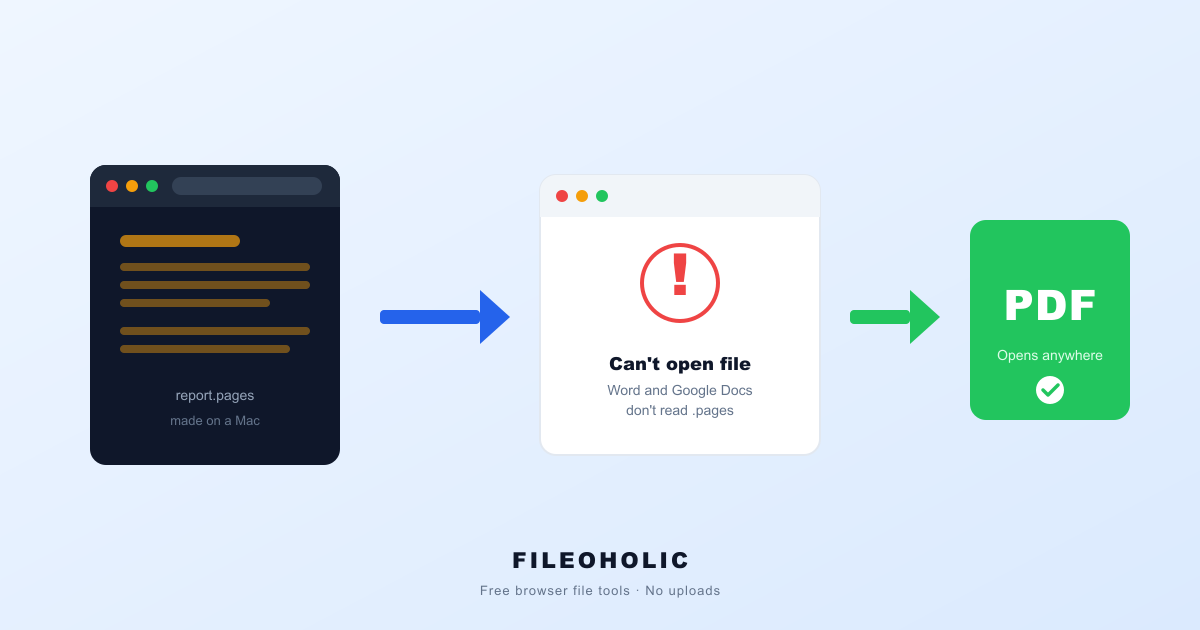
Someone on a Mac sends you a document. You go to open it on your Windows PC and nothing happens. The file is called report.pages, Word won't touch it, Google Docs won't import it, and double-clicking makes Windows ask which program you'd like to fail with.
Short answer: .pages is Apple's private word-processor format, and nothing outside Apple's own apps reads it directly. You don't need a Mac to fix this — you need something that reads the file on your own computer and gives you a PDF. Here's why it happens and the fastest free way through it.
What a .pages file actually is
Pages is Apple's word processor — the Mac, iPhone and iPad answer to Word, free on every Apple device. When you save in Pages, it doesn't write a Word file. It writes its own .pages format.
Since 2013 that format has been an iWork Archive: a compressed bundle holding Apple's internal data, encoded the way the Pages app likes it rather than the way the rest of the world reads documents. Inside there is an Index.zip of binary records, a Metadata folder, and a small preview.jpg of the first page for thumbnails. There is no "open a Pages file" button in Windows because Apple never built the format to be opened anywhere but Apple's own apps. It's the same story as a .numbers spreadsheet and an iPhone's HEIC photos — a file you own, in a format only one company reads.
Why Word and Google Docs both refuse it
Word opens .docx, .doc, .rtf, .odt and a few more. Google Docs imports those. Neither list includes .pages — not because it's hard, but because it's a competitor's private file type and neither has a reason to support it. So the document that opens perfectly on your colleague's Mac is, on your PC, a dead end until something reads it for you.
Fix 1: open it in your browser and save as PDF (no Mac, no install)
The quickest route, and the one that needs nothing but the file you already have: drop the .pages file into our Pages to PDF tool. It reads the bundle on your own device, rebuilds the document — text, images, tables, charts — and shows it page by page. Press Save as PDF and choose Save as PDF in your browser's print dialog. You get one PDF page per document page, with real text you can search and copy.
Nothing is uploaded; the document never leaves your computer, which matters when it's a contract, a CV or a school report. Works for modern Pages files from 2013 onward — Mac, iPhone, iPad and iCloud — and for the old Pages '09 format too.
Fix 2: if you have access to a Mac or iPhone
Have an Apple device within reach? Open the file in Pages, then choose File → Export To → PDF or → Word and send yourself the result. It's the most faithful copy you can get, fonts and all — but it's no help if the whole problem is that you don't have a Mac, which is exactly why most people land here.
Fix 3: iCloud in a browser (needs an Apple ID)
If you have an Apple ID, you can upload the file to iCloud Pages on the web, open it, and export to PDF or Word from there. It works, but it means using or creating an Apple account and uploading your document to Apple's servers — more steps and less private than reading the file locally.
What doesn't work: renaming it to .zip and hoping
You'll find advice online to rename document.pages to document.zip, unzip it, and look inside. What you'll find is a preview.jpg — a low-resolution picture of the first page — and an Index.zip of binary data no ordinary program reads. On very old Pages '09 files there was sometimes a full QuickLook/Preview.pdf inside; files saved by any Pages from the last decade don't carry one. The trick gives you a thumbnail, not the document.
PDF or Word — which do you actually need?
| You want to… | Get | How |
|---|---|---|
| Read it, print it, send it on | Pages to PDF in your browser, above | |
| Edit the text | Word (.docx) | Ask the sender to export to Word, or open the PDF in Word |
| An exact copy, fonts included | PDF from Pages itself | Needs a Mac, iPhone or iCloud |
FAQ
Can Windows open a .pages file at all?
Not on its own. Windows has no reader for Apple's .pages format, and neither Word nor Google Docs can import it. You need something that understands the format — either an Apple app, or a browser tool that reads the file on your device and shows or converts it.
Is there a free way to open a Pages file without a Mac?
Yes. A browser-based reader opens the .pages file on your own computer, shows every page, and can save it as a PDF. No Mac, no Apple ID, no install. Our Pages to PDF tool does exactly this and never uploads the document.
Will the document look the same as on the Mac?
Very close. Text, images, tables and layout come through. The one thing that can shift is fonts: if the document used a font your PC does not have, the browser substitutes a similar one, and a line may break in a different place. A PDF exported from Pages itself is always the most exact copy, if the sender can make one.
Can I turn a .pages file into a Word document?
The sender can, with File → Export To → Word in Pages. Without a Mac, the practical route is Pages to PDF in your browser, then open the PDF in Word — Word converts most PDFs into editable text well enough to work with.
The file came as a folder full of things, not one file. What happened?
Some email and cloud services unpack the .pages bundle and hand you a folder with an Index.zip, a Metadata folder and preview images inside. Ask the sender to compress the document to a .zip before sending, or to export it to PDF. A folder like that cannot be opened as a document.
Does the preview.jpg inside the file help?
Only a little. A .pages bundle carries a small picture of the first page for thumbnails. It is low resolution, one page only, and it is not the document. Tools that show you that picture and call it a conversion are showing you the thumbnail.
The five-second workflow
- A
.pagesfile is an Apple-only document — Windows, Word and Google Docs can't read it as-is. - No Mac needed: open it in your browser and save as PDF, free, nothing uploaded.
- Got a Mac or iPhone handy? Export to PDF or Word from the Pages app instead.
- Have an Apple ID and don't mind uploading? iCloud Pages can export too.
It's a small, maddening wall — a document that works two feet away on a Mac and not at all on your PC. But the words were never really trapped. Open the file once, save the PDF, and that .pages attachment becomes an ordinary document you can actually read.